Jordan Price
JAN 18, 2026
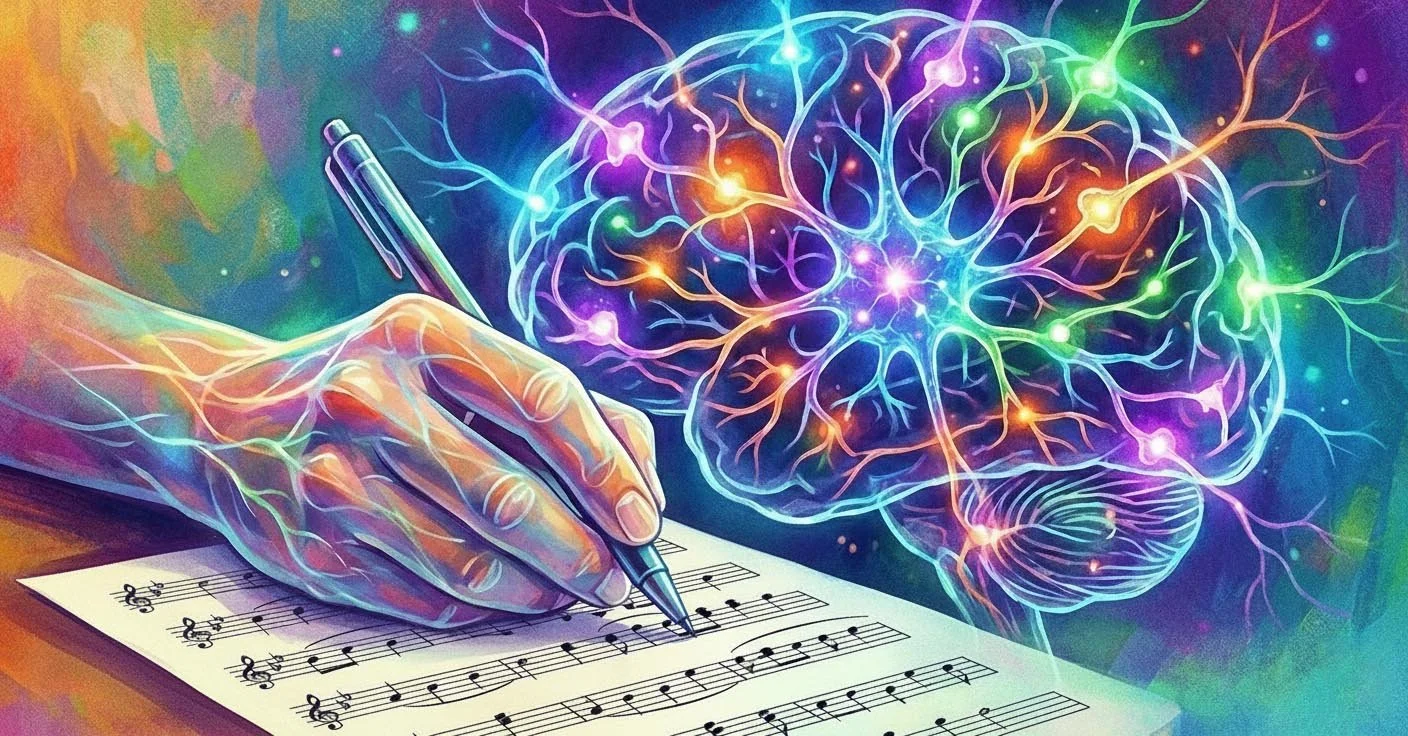
Why your brain lights up when you pick up a pen.
When you write by hand, your brain doesn’t just store words. It builds a little movie of how each letter feels. Every curve, every pause, every tiny correction pulls in motor areas, visual processing, and memory circuits at the same time.
Typing, in comparison, is flatter. The motion is almost identical for every letter: tap, tap, tap. Keys don’t change. Muscles repeat. Your brain gets away with doing less work, so it actually lays down fewer rich traces.
That extra effort with a pen is not wasted energy. It’s what makes the information stick. The brain loves patterns that involve many regions firing together, and handwriting is exactly that kind of full body, full mind pattern. In a way, your notes become less a transcript and more a physical map of your thinking.
In 2023, Norwegian researchers wired up students with EEG caps and asked them to take notes either by hand or on a keyboard. On the screens, the difference was almost shocking: handwriting triggered far wider and more coordinated brain activity, especially in areas tied to memory and learning.
Students who wrote by hand were not only more engaged in the moment. Later, when tested, they showed stronger recall and better understanding of what they’d heard. Their brains had quite literally worked harder at the time of note taking, and that work paid off like a good workout does a week later.
One of the researchers described handwriting as a kind of “sensorimotor festival” for the brain. With a keyboard, your fingers glide in nearly automatic patterns. With a pen, each word is a small choreography. That choreography anchors ideas in a way that simple taps can’t quite replicate.
Across other studies, the pattern keeps repeating. Children who learn letters by tracing and writing them often read more fluently. Adults who handwrite their to do lists remember them better. Even older adults show sharper recall when they jot things down instead of just typing or tapping them into a phone.
It’s not that keyboards are bad. They’re simply efficient. Maybe too efficient for a brain that learns best when it has to wrestle a little with what it wants to keep.
How to use handwriting strategically in a digital life
You don’t need to throw your laptop out the window to benefit from this. Think of handwriting like a high intensity workout you sprinkle into your routine, not a strict lifestyle change…
Instead, tilt towards questions, summaries, and links. Write “What does this remind me of?” or “This contradicts what I thought last week.” Your notes become a conversation, not a storage unit.
“Handwriting creates a unique neural signature for what you learn. It’s like giving each idea its own fingerprint in the brain.” — Cognitive neuroscientist quoted in a 2023 learning study
Small changes in how you set up your handwritten moments can multiply their impact. Think of them as tiny design tweaks for your brain’s interface…**When the hand moves with intention, the brain usually follows.**…
Letting ink change how you remember your own life
…We’re not going back to quills and inkpots. Screens are here, and they’re not the enemy. The real question is which moments in your day deserve that extra layer of brain activity, that richer trace. Learning something new? Crafting a plan for a difficult year? Trying to remember what truly matters to you?
Those might be the moments to reach for a pen, even if your handwriting is ugly or slow. Especially then, maybe. **Imperfect lines have a way of calling you back later**, reminding you that a real, slightly messy human was there, thinking hard.
And that human was you.
| Key Point | Detail | Interest to the Reader |
|---|---|---|
| Handwriting activates more brain areas | Motor, visual, and memory regions fire together while writing by hand |
Better chances that what you learn actually sticks |
| Typing is efficient but shallow | Repeated key presses create less varied neural patterns |
Explains why dense typed notes can still feel forgettable
|
| Use handwriting in targeted moments | Daily digests, key meetings, difficult topics |
Gain memory benefits without abandoning digital tools
|
FAQ :
• Does handwriting always beat typing for memory? In most learning studies, handwriting leads to stronger recall, especially for complex material, but mixing both can work well if you use handwriting at key moments of reflection.
• What if my handwriting is slow or messy? That’s fine. The mental effort and physical movement matter more than neatness, and going slower can actually deepen understanding.
• Can tablets and styluses give the same benefits? Writing on a tablet with a pen like stylus tends to activate similar brain areas, as long as you’re forming letters and shapes with your hand, not just tapping.
• Is it worth teaching kids cursive in a digital age? Research suggests that learning to write by hand, including cursive, supports reading, attention, and memory, so it still brings real cognitive benefits for children.
NOTES by Susanna Briselli:
This article has been edited and condensed for a more specific relevance to The Mind to Music Project rather than in learning and education. The author, Jordan Price, appears to be a general content writer and frequent contributor to the online site Vinylone.co.uk. Though not a specialist, he focuses broadly on topics such as neuroscience, education, or writing research. This article reflects a popular summary of research findings regarding how writing by hand affects the brain in contrast to how the brain reacts to keyboard typing and computer use. It is included in this website for obvious reasons in that it provokes questions about the musicians’ choice to notate scores by hand. It does not reflect a preference for one approach over another.
> Return to the Essays & Articles or click below:
Digital Dexterity: Composing on Computer
Should We Still Teach Students To Hand-Write Music?
How Much Is Too Much When Writing on Sheet Music?
Why Your Brain Lights Up When You Pick Up a Pen
Musicians Embrace the iPad, Leave Sheet Music at Home